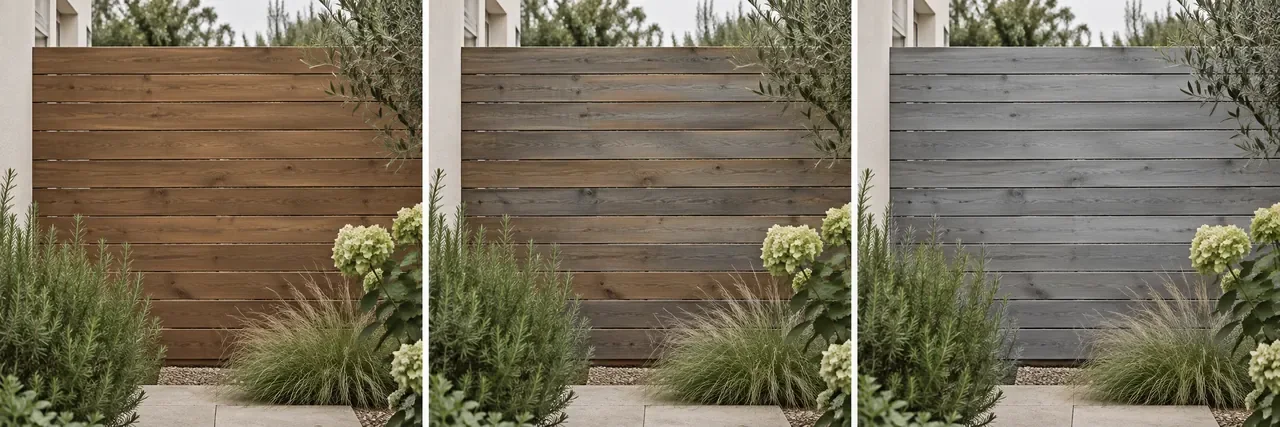
Three views comparing the appearance of a garden wood screen.
Illustrative appearance study, not a dated exposure test. Color does not establish age, strength or decay.Repeat the viewpoint, light and context—not just the subject.
Establish a station
Choose a fixed feature that lets you stand in the same place: a paving joint, window edge or marked viewpoint on a plan. Photograph both the whole assembly and a repeatable close view. Keep the original file rather than only a cropped social-media copy with unknown processing.
Record the conditions
Write down the date, visible surface wetness, lighting and any recent work. Automatic phone processing can change contrast and colour between images. A neutral reference card may help document the scene, but a casual photograph is not a calibrated laboratory colour measurement.
Use the images as evidence of observations
Arrange comparison images with their dates and notes. Do not put a calendar interval under a generated scene or use different installations as an unlabeled time sequence. If one reference is a design inspiration, say so in the project record. The journal keeps observation and expectation separate.
- Wide view plus detail
- Repeat angle and distance
- Retain date and surface condition
Make the second photograph possible when you take the first
A repeatable photograph needs an identifiable subject and viewpoint. Choose a fixed panel, board or small group of boards and include a landmark that survives ordinary use. Take one overview locating the subject and one closer image showing the surface. A close crop without location is difficult to repeat and easy to misinterpret later.
Keep the original files. Record the date, surface wetness, finish history and any recent treatment. If the installation date is unknown, leave it unknown. A camera timestamp can establish when the photograph was taken, but it cannot establish the age of the wood or the duration of its exposure.
Control the differences you can control
Try to repeat the camera position, framing and lighting condition. Strong direct light, deep shade and an overcast sky can make the same wood look substantially different. Avoid comparing one image with automatic enhancement against another made with a different filter. If your camera allows consistent settings, retain them; if it does not, note that the record is a visual comparison rather than a calibrated colour measurement.
A neutral reference placed consistently in the frame can help identify lighting shifts, but it does not turn an ordinary phone image into laboratory colorimetry. Do not use a numerical colour difference extracted from uncalibrated photographs as a precise material-performance result. The practical objective is a fair, interpretable visual history.
Scroll sideways to read all columns. Keyboard: focus the table and use the arrow keys.
| Capture | Include | Why keep it? |
|---|---|---|
| Overview | Surface, shelter and surroundings | Locates the exposure |
| Repeat view | Same boards and framing | Shows change at a known location |
| Detail | Texture and a recognizable scale reference | Shows features hidden in the overview |
| Context note | Dry or wet, recent cleaning, finish work | Prevents an unrelated change being called weathering |
Separate wet appearance from dry appearance
A wet surface often appears different from the same surface when dry. Keep wet-condition images as their own series and label them accordingly. If a photo is taken immediately after cleaning, it belongs to that treatment event as well as the appearance record. Comparing it directly with an older dry surface can exaggerate an apparent improvement or colour change.
For a useful sequence, wait for comparable surface conditions rather than forcing every photograph onto a fixed calendar date. If comparable conditions are unavailable, keep the observation and its limitation. An honest uneven record is more useful than a polished sequence assembled from unmatched images.
Write captions that carry the evidence
A useful caption identifies the material as known or reported, the face, the location within the project, the date and relevant treatment. For example: north panel, boards N3–N5, photographed dry after an overcast morning, no treatment recorded since the previous image. Do not add a species or elapsed age because it seems visually plausible.
Use the observation journal to retain the images and notes together. The wet-versus-dry guide and seasonal record guide explain how to interpret the resulting sequence. This is an original field-photography workflow; it does not claim that the photographs establish structural condition or standardized weathering performance.
Evidence & scope
Surface weathering research (2020), not a forecast for a supplied board or a structural assessment.
Original planning guidance. References support their stated technical scope; examples and workflows do not establish product approval.