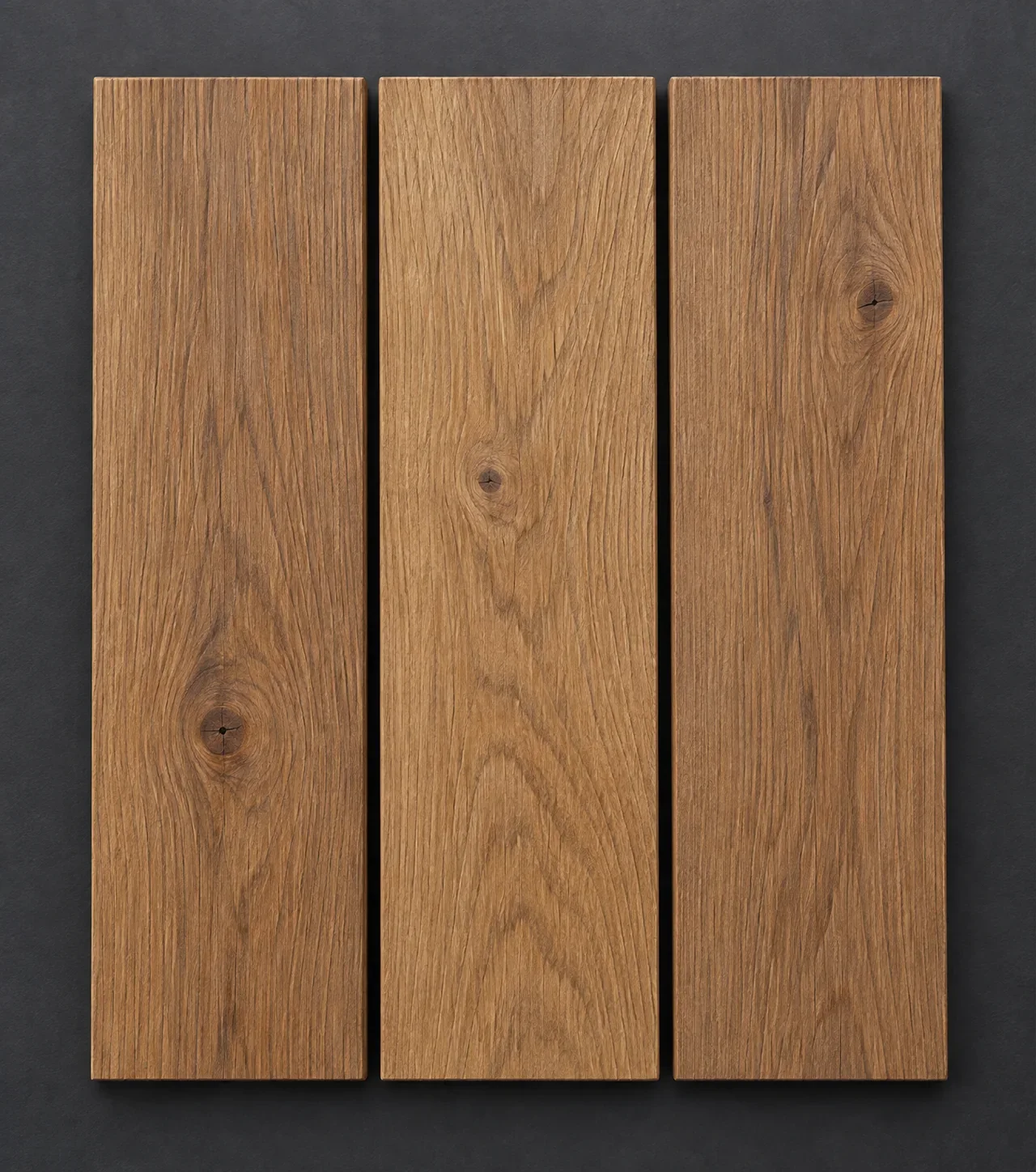
Three warm brown wood samples under consistent neutral lighting.
Illustrative appearance study, not a dated exposure test. Color does not establish age, strength or decay.Compare surfaces at a consistent visible condition.
Make two records
A recently wet surface can appear different from the same surface after drying. Label photographs by observed condition rather than rewriting the original colour description. If some boards are dry and others visibly wet, preserve that distinction in your notes instead of describing the whole assembly as one tone.
Avoid an improvised moisture test
Colour alone cannot establish moisture content. The observation journal does not convert a darker image into a meter reading. Where a coating or installation decision requires a moisture limit, use the relevant product instructions and an appropriate measurement process, recording the method and material information.
Keep the comparison fair
For a before-and-after discussion, use photographs taken in similar weather and light. If that is not possible, display the difference openly. A cleaning result photographed wet should not be presented as proof of its final dry appearance. Ask for a later dry observation before deciding whether the outcome matches the brief.
- Label visible wetness
- Keep original photographs
- Separate readings from appearance notes
Compare the same surface in the same condition
A photograph after rain answers a different question from a photograph of a dry surface. Before calling a board darker, cleaner or more evenly weathered, check the condition in which both observations were made. Reflections, shadow and surface water can obscure the texture you are trying to compare. Keep both images; label the difference rather than discarding inconvenient evidence.
For a useful field pair, identify a small group of boards by location and capture the same view after the surface has returned to a comparable dry condition. Note recent cleaning, finish application, overhead cover and anything resting on the boards. Do not wet an electrical or otherwise unsuitable area merely to create a comparison photograph.
In this illustrative example, a Monday photograph after rain looks darker than a dry Thursday photograph. The two images establish an appearance difference under different conditions. They do not show that three days of weathering removed colour, that the wood absorbed a particular quantity of water, or that a coating failed.
An observation pair that can be interpreted
Scroll sideways to read all columns. Keyboard: focus the table and use the arrow keys.
| Record | First image | Repeat image |
|---|---|---|
| Location | West panel, boards W2–W4 | Same panel and boards |
| Surface | Wet after rain | Visibly dry; drying history noted |
| Treatment | None recorded since last visit | No intervening treatment reported |
| Interpretation | Wet-condition appearance | Dry-condition appearance; not a measured weathering rate |
If a finish sample is part of the comparison, identify its product and application history separately. A wet untreated board is not a reliable preview of the dry appearance of a particular finish. Use an actual sample prepared according to the selected product instructions.
Evidence & scope
Surface weathering research (2020), not a forecast for a supplied board or a structural assessment.
Original planning guidance. References support their stated technical scope; examples and workflows do not establish product approval.