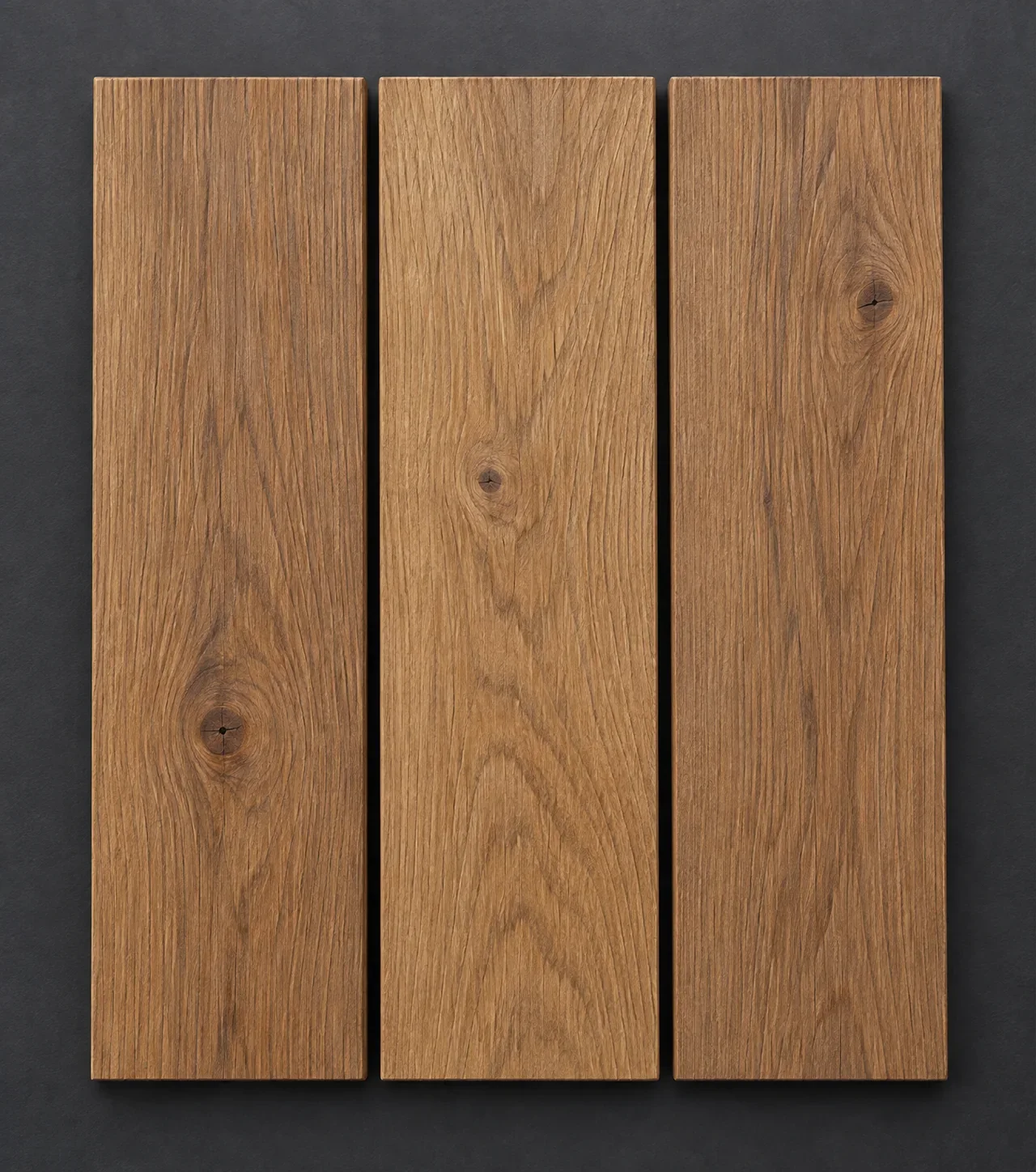
Three warm brown wood samples under consistent neutral lighting.
Illustrative appearance study, not a dated exposure test. Color does not establish age, strength or decay.Ask about the exact finish rather than relying on a category name.
Identify the system
Clear, tinted and pigmented are useful starting descriptions, but not complete specifications. Obtain the exact product name, substrate compatibility, exposure suitability and current instructions. An interior clear finish is not automatically suitable outdoors just because its colour is appealing.
Understand what is being compared
Different products can alter colour, grain visibility and maintenance needs. A reference swatch on one wood may not predict appearance on your material. Request a sample on the actual product and document its preparation. Do not infer UV protection or water performance from visual transparency alone.
Retain the application record
Keep the product revision, applied coats and known preparation with the project file. When discussing future maintenance, that record helps avoid incompatible assumptions. This guide frames questions for a finish supplier; it does not prescribe a universal product, recoating interval or preparation method.
- Record exact product and revision
- Test the actual material
- Separate appearance from performance
Clear describes appearance, not the complete protection system
A clear finish allows more of the underlying wood to remain visible. A pigmented finish adds colour and changes how light reaches the surface. Transparency, film formation, water repellency and suitability for the application are separate properties. A product can be clear and film-forming, or pigmented and penetrating; the label oil does not answer every one of those questions.
The USDA's exterior-stain research explains that pigments can help protect the surface from sunlight and that clear finishes expose the coating–wood interface to light. It also distinguishes penetrating and film-forming behavior. Use those principles to read a current product's documentation, not to transfer an old formulation's service interval to a different finish. Selection and application of exterior stains for wood is background research, not a product recommendation.
Compare samples on the wood you intend to use
A colour chip is a starting point. The underlying wood colour, preparation and application affect the final appearance. Prepare samples using the proposed material and the product's stated method. Include enough area to see grain variation rather than approving only a tiny, unusually attractive patch.
View the samples in the intended setting, with the finish in the condition specified for assessment. A freshly wet application is not the final dry appearance. Keep an untreated comparison where practical, and identify the exact product and colour on the back of each sample. Similar names such as natural or clear are not specifications across brands.
Scroll sideways to read all columns. Keyboard: focus the table and use the arrow keys.
| Question | What to compare |
|---|---|
| How much grain remains visible? | Dry sample on the intended wood |
| How much colour is added? | Same wood and preparation across options |
| What changes during exposure? | Relevant product evidence and a local observation sample |
| What does renewal involve? | Product-specific preparation and recoat instructions |
| Where can it be used? | Explicit approval for the intended surface and exposure |
Choose the future appearance as well as the first-day colour
Some owners want the initial brown appearance to remain as consistent as possible. Others prefer the wood to weather naturally. A transparent finish may appeal because it changes the starting colour less, but its renewal requirements still need to be understood. A more pigmented finish may alter the initial look more while addressing a different appearance objective.
Ask what the owner will accept between maintenance visits. Uniformity, visible grain, colour retention and easy renewal can involve tradeoffs. A sample approval should describe the chosen priority rather than simply saying approved finish. The project also needs an agreed response if a later replacement board looks different.
Avoid a universal calendar
Exposure and product requirements should shape the care discussion. Sheltered vertical surfaces and open horizontal surfaces experience different conditions, so a single interval copied across both is not a useful appearance promise. Check the selected product's current guidance and observe the actual surface.
The purpose of this page is to clarify the visual decision. Detailed cleaning, preparation and application belong to the current instructions for the selected system. Continue with the appearance brief and new boards beside weathered boards to describe the result you want without promising an exact colour or fixed lifetime.
Evidence & scope
General finishing reference (1999). Product instructions and current project conditions take precedence; no service-life figures are adopted.
Original planning guidance. References support their stated technical scope; examples and workflows do not establish product approval.