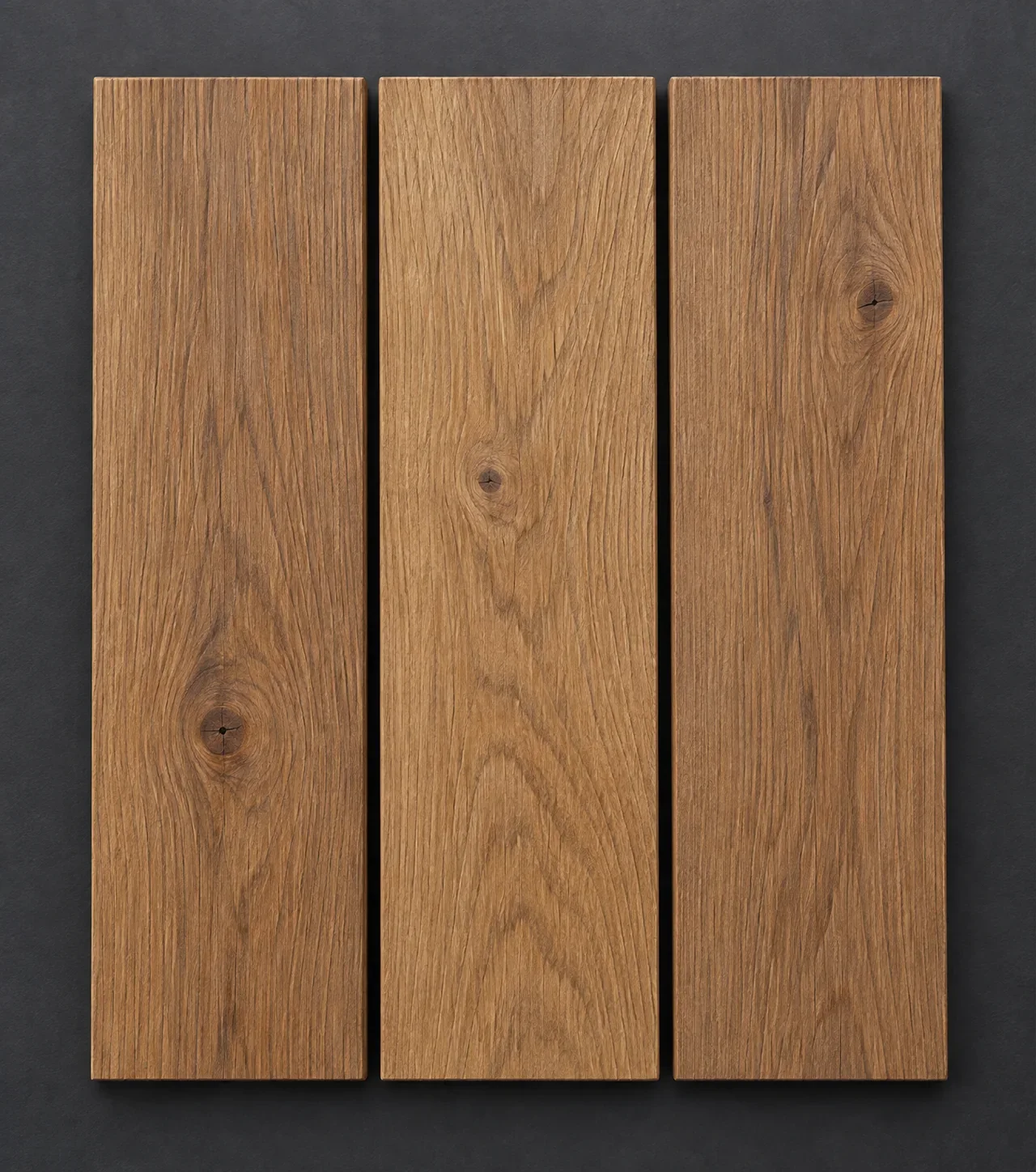
Three warm brown wood samples under consistent neutral lighting.
Illustrative appearance study, not a dated exposure test. Color does not establish age, strength or decay.A replacement creates a new starting condition in an older setting.
Record what changed
Identify which boards were replaced, when and with what documented product. Do not assume the new material matches the original species, machining or coating because the invoice uses a similar trade name. Keep the existing finish history and the replacement details together.
Avoid a colour deadline
A prediction that the new board will match by a certain month can create an expectation unsupported by evidence. Shelter, finish history and starting appearance may differ. Ask the supplier what product-specific information is available and distinguish experience from a guarantee.
Choose the scope of the appearance decision
Discuss whether the contrast is acceptable, whether a sample review is useful, or whether a broader finish plan should be considered. Do not extend replacement work solely to chase a photo-perfect match without documenting the cost and scope decision through the appropriate commercial process.
- Identify replacement locations
- Record old and new finish history
- Agree acceptable contrast
Plan for a visible repair before ordering
A replacement board introduces a different surface history into an existing field. Matching the species name does not establish an immediate colour match. Compare the proposed piece with the existing surface in comparable conditions and include the full board layout in the review, not only a tightly cropped close-up.
Ask the owner which result matters most: replacing a damaged piece promptly, keeping a particular finish system, or reducing the visual contrast across a larger area. These choices can lead to different scopes of work. Do not promise that a new board will blend within a specific number of months.
For example, one newly supplied board in a grey field may be conspicuous even when its dimensions and interface are correct. Record the acceptance of that contrast before installation. If broader surface treatment is proposed, test the complete treatment on an appropriate sample area and follow the product instructions; a photograph cannot establish compatibility.
Separate fit acceptance from appearance acceptance
Scroll sideways to read all columns. Keyboard: focus the table and use the arrow keys.
| Review | What to compare | What remains separate |
|---|---|---|
| Physical replacement | Actual profile, condition and attachment requirements | Structural or fastening approval |
| Immediate appearance | Sample beside existing dry surface | Future colour prediction |
| Treatment proposal | Documented product and trial area | Whole-project result |
| Owner acceptance | Agreed visible contrast and scope | A promise of eventual uniformity |
Keep the replacement date in the appearance record. A mixed-age installation should be described as mixed-age; it is misleading to label every board with the age of the original project.
Evidence & scope
Surface weathering research (2020), not a forecast for a supplied board or a structural assessment.
Original planning guidance. References support their stated technical scope; examples and workflows do not establish product approval.