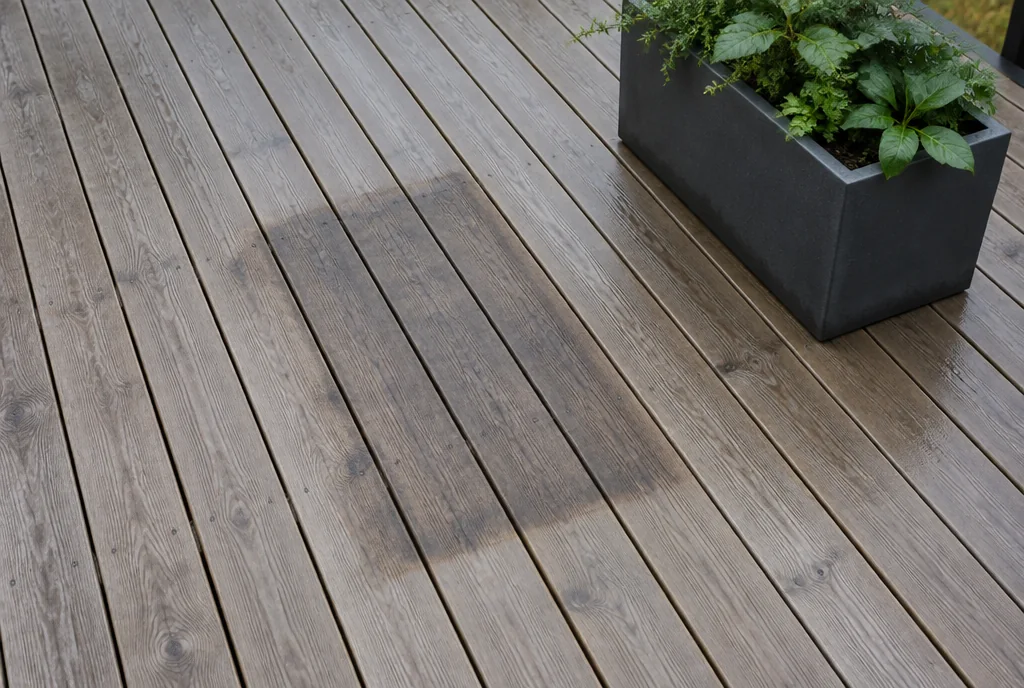
A hypothetical planter footprint: record the shape, location and nearby object before deciding what the mark means.
Illustrative observation scene. The mark does not establish a particular stain, biological growth, decay or treatment requirement.Appearance alone cannot identify the cause of a stain.
Describe the pattern
Record whether the mark follows metal, runoff, an object, a joint or a shaded zone. Note when it was first observed and whether the surface was wet. These details can guide a useful question, but no single pattern proves a chemical, biological or finish-related cause.
Do not experiment across the whole area
Avoid applying an improvised cleaner based only on an image match. Product compatibility, adjacent materials and runoff management matter. This site does not provide chemical recipes. For a proposed treatment, obtain product-specific instructions and an appropriate small-area trial process from the responsible supplier.
Preserve the original condition
Take context and detail photographs before changes. Record what was applied and where if prior work occurred. When a specialist reviews the condition, a clear history is more useful than a cleaned patch with no record of the original mark. Keep uncertain causes labeled as questions.
- Document nearby metal and water
- List known treatments
- Request diagnosis before corrective work
A pattern suggests a question, not an answer
A broad change across an exposed face and a localized mark beside a fitting deserve different records. Neither pattern identifies its cause on its own. Start by comparing the affected area with a nearby area on the same board or assembly, while recording differences in shelter, water paths, previous treatment and surface condition.
One documented possibility is iron staining. The USDA Forest Products Laboratory describes discoloration produced when iron reacts with wood extractives in the presence of water. That mechanism explains why nearby metal can be relevant evidence; it does not prove that a particular dark mark is iron stain. See Iron Stain on Wood.
Scroll sideways to read all columns. Keyboard: focus the table and use the arrow keys.
| Observation | Record alongside it | Do not conclude from the image alone |
|---|---|---|
| Mark near a fitting | Fitting location, known material, runoff and first observation | Exact alloy or chemical cause |
| Patch below an object | Object footprint, duration in place and exposure difference | Decay, mold or a particular treatment failure |
| Line along a water path | Source of water, recent rain and wet/dry condition | That the water carried one identified contaminant |
| Broad color change | Comparable exposed and sheltered views, finish history | A specific age or remaining service life |
Worked observation: a mark below a planter
In a fictional journal entry, an owner records a dark rectangular area where a planter stood. The first photograph was taken just after the planter was moved on a wet morning. The useful entry is “dark area matching the planter footprint; surface wet; prior coating unknown.” Calling it rot or chemical staining would add a conclusion the record does not support.
Keep the original photograph. If the area can be approached safely, add a wider view showing the planter location and a later view under documented comparable conditions. Record any cleaning or movement between views. A change after drying is a new observation, not proof of the cause. If physical damage or softness is suspected, move the question out of the appearance journal and into an appropriate condition assessment.
Before a treatment changes the evidence
- Save an untreated overview and close view with a stable location reference.
- List known finish and cleaning products; write unknown where records are missing.
- Describe whether the concern is color, texture, a loose fragment or possible physical deterioration.
- Ask the reviewer what information is needed before choosing a treatment.
- Record any authorized trial area, product and date so later photographs remain interpretable.
This page supports appearance documentation. It does not supply chemical identification tests, cleaner recipes or a structural assessment. The Forest Products Laboratory finishing chapter provides broader background on wood surfaces, finishes and outdoor exposure.
Evidence & scope
Surface weathering research (2020), not a forecast for a supplied board or a structural assessment.
Original planning guidance. References support their stated technical scope; examples and workflows do not establish product approval.